cat 6 wiring diagram pdf
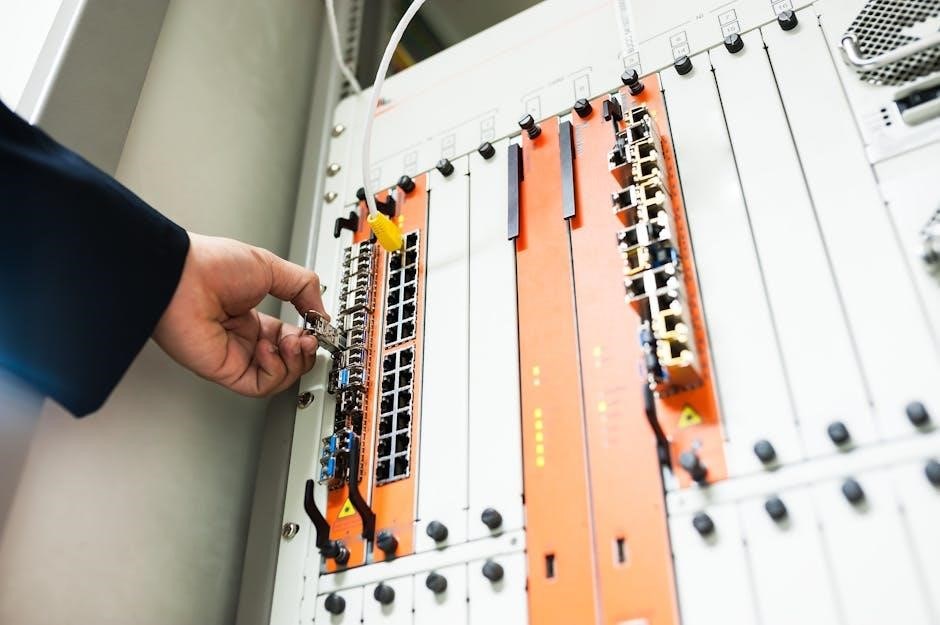
Cat 6 Wiring Diagram PDF: A Comprehensive Guide
Navigating the complexities of network installations requires reliable resources; a Cat 6 wiring diagram PDF offers detailed schematics for efficient and accurate cable connections, ensuring optimal performance.
Essential for both professionals and DIY enthusiasts, these diagrams simplify the process of creating robust and dependable network infrastructure, minimizing errors and maximizing speed.
Cat 6 cabling represents a significant advancement in network technology, designed to handle the increasing bandwidth demands of modern applications. It’s a twisted pair cable standard commonly used in Ethernet networks, capable of supporting data transfer rates up to 10 Gigabit Ethernet over shorter distances. Understanding its capabilities is crucial for building reliable and high-performance networks.
Compared to its predecessors like Cat 5 and Cat 5e, Cat 6 offers improved specifications for crosstalk and system noise, leading to more stable and faster connections. This makes it ideal for environments requiring substantial data throughput, such as businesses, data centers, and homes with multiple bandwidth-intensive devices. A Cat 6 wiring diagram PDF is an invaluable tool for ensuring correct installation, maximizing performance, and avoiding potential network issues. Proper implementation, guided by these diagrams, is key to unlocking the full potential of Cat 6 cabling.
Furthermore, the robustness of Cat 6 makes it a long-term investment in network infrastructure.
What is a Cat 6 Wiring Diagram?
A Cat 6 wiring diagram is a visual representation illustrating the precise arrangement of wires within a Cat 6 cable and its connection to RJ45 connectors. These diagrams are essential for terminating Cat 6 cables correctly, ensuring optimal network performance and minimizing signal interference. Typically, a Cat 6 wiring diagram PDF will depict the color-coding scheme for each wire, adhering to either the T568A or T568B standard.
These diagrams aren’t merely visual aids; they are critical blueprints for creating both straight-through and crossover cables. A straight-through cable uses the same wiring standard on both ends, while a crossover cable reverses the wiring on one end. Accessing a clear and accurate Cat 6 wiring diagram PDF is vital for anyone installing or troubleshooting network cabling, guaranteeing a reliable and efficient network connection. They simplify a potentially complex process, reducing errors and saving time.
Essentially, it’s a roadmap for successful network cabling.
Understanding T568A and T568B Standards
T568A and T568B are the two primary wiring standards used when terminating Cat 6 cables, and a Cat 6 wiring diagram PDF will clearly illustrate both. While both standards function correctly, consistency is key – mixing them can cause connectivity issues. T568B is more commonly used in North America, while T568A was originally designed for older systems but remains viable;
The core difference lies in the arrangement of the orange and green wire pairs. A Cat 6 wiring diagram PDF will show that T568A places green and orange pairs in positions 1 & 2 and 3 & 6 respectively, while T568B swaps these, putting orange and green in positions 1 & 2 and 3 & 6. Choosing a standard and adhering to it throughout your network is crucial. Using a Cat 6 wiring diagram PDF ensures you maintain the chosen standard for every connection.
Proper implementation avoids network conflicts.

Components of a Cat 6 Wiring Diagram
A Cat 6 wiring diagram PDF details essential elements: the cable itself, RJ45 connectors, and specialized crimping tools, all vital for a successful installation.
Cat 6 Cable Construction
Cat 6 cables are meticulously engineered for superior performance, differing significantly from older standards. A Cat 6 wiring diagram PDF often highlights the internal structure, revealing twisted pairs of copper wires – typically 23 or 24 AWG – encased in a protective jacket.
Crucially, Cat 6 cables incorporate a spline or separator between these twisted pairs, minimizing crosstalk and interference. This design is paramount for maintaining signal integrity, especially over longer distances. Some Cat 6 cables also feature a foil shield or braided shield surrounding the wires, further enhancing protection against electromagnetic interference (EMI).
Understanding this construction is vital when referencing a Cat 6 wiring diagram PDF, as proper handling and termination techniques are essential to preserve the cable’s shielding and twisted pair configuration. Damage to these elements can severely degrade network performance, making accurate wiring crucial.
RJ45 Connectors: Types and Specifications
RJ45 connectors are the interface points for Cat 6 cabling, and a Cat 6 wiring diagram PDF will often detail the correct connector usage. While appearing similar, connectors vary; Cat 6 connectors are specifically designed to accommodate the thicker gauge wires and tighter twists found in Cat 6 cable.
Standard RJ45 connectors are typically made of plastic with internal metal contacts for conductivity. However, for shielded Cat 6 installations, shielded RJ45 connectors are necessary to maintain the cable’s shielding integrity. These connectors have a metal shell that grounds to the cable’s shield, preventing EMI.
When consulting a Cat 6 wiring diagram PDF, pay attention to connector specifications – ensuring compatibility with the cable type (shielded or unshielded) is critical for optimal network performance and reliable connections. Incorrect connector selection can negate the benefits of Cat 6 cabling.
Crimping Tools and Their Importance
A quality crimping tool is paramount when working with Cat 6 cabling, and a Cat 6 wiring diagram PDF assumes you possess one. Proper termination relies on a secure connection between the wire strands and the RJ45 connector pins. Inferior tools can lead to loose connections, signal degradation, and network instability.
Specifically, Cat 6 crimping tools are designed with dies that precisely match the thicker gauge wires of Cat 6 cable. These tools often feature a built-in wire stripper and cutter, streamlining the process. Look for tools with adjustable tension settings to ensure a consistent, reliable crimp.
Referring to a Cat 6 wiring diagram PDF will show the correct wire sequence, but even perfect sequencing is useless without a solid crimp. Investing in a reputable crimping tool is a small price to pay for a stable and high-performing network.

Step-by-Step Wiring Process
Following a Cat 6 wiring diagram PDF, carefully strip the cable jacket, arrange wires per the chosen standard, and insert them into the RJ45 connector.
Ensure each wire reaches the connector tip before crimping for a secure, reliable connection.
Preparing the Cat 6 Cable
Initial cable preparation is crucial for a successful Cat 6 installation, guided by your chosen Cat 6 wiring diagram PDF. Begin by carefully removing the outer jacket of the cable, typically around 1-2 inches, exposing the twisted pairs within.
Avoid nicking or damaging the individual wires during this process, as this can significantly degrade signal quality. Untwist the pairs only as much as necessary to facilitate wiring into the RJ45 connector – minimizing untwisting maintains the cable’s shielding properties.
Arrange the wires according to the T568A or T568B standard (detailed in the diagram), ensuring they are flat and parallel. A slight straightening of the wires can aid in insertion. Finally, trim the ends of the wires to a uniform length, approximately ½ inch, for a clean and secure crimp.
Proper preparation ensures optimal performance and reduces the risk of connection errors.
Wiring According to T568A Standard

Following a Cat 6 wiring diagram PDF, the T568A standard dictates a specific color code for optimal network performance. Begin with the solid green wire on the far left, followed by the solid orange, solid white-blue, blue, white-orange, orange, white-blue, and finally, white-green.
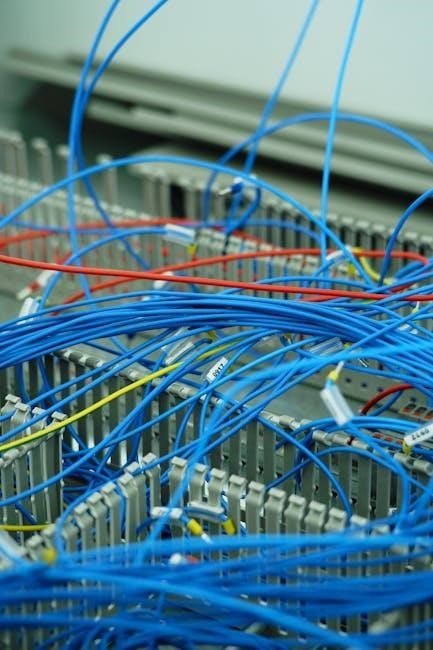
Maintaining this precise order is paramount; any deviation can lead to connectivity issues. Ensure the wires remain flat and parallel as you carefully position them within the RJ45 connector. The outer jacket of the cable should be securely gripped by the connector’s strain relief.
Double-check the color arrangement against your Cat 6 wiring diagram PDF before proceeding to crimping. This standard is commonly used in North America and is essential for creating straight-through cables or one end of a crossover cable.
Accuracy in wiring guarantees a reliable and high-speed network connection.
Wiring According to T568B Standard
Utilizing a Cat 6 wiring diagram PDF for the T568B standard involves a different color arrangement than T568A. Start with the solid orange wire on the far left, then solid white-blue, solid blue, white-orange, solid green, white-green, solid brown, and finally, white-brown.
This standard is widely adopted and often preferred due to compatibility reasons. As with T568A, meticulous attention to detail is crucial. Ensure wires are flat, parallel, and securely held by the RJ45 connector’s strain relief before crimping.
Always verify the color sequence against your Cat 6 wiring diagram PDF to avoid errors. T568B is frequently used for straight-through cables and the opposite end of crossover cables, offering flexibility in network configurations.
Proper implementation of this standard ensures a stable and efficient network connection.

Troubleshooting Common Issues
A Cat 6 wiring diagram PDF aids in diagnosing connectivity problems. Utilize cable testers to pinpoint breaks, shorts, or incorrect wiring, ensuring optimal network performance.
Identifying Wiring Errors
A crucial step in network setup involves accurately identifying wiring errors, and a Cat 6 wiring diagram PDF serves as your primary reference. Begin by visually inspecting the cable terminations against the diagram, confirming each wire corresponds to the correct position in both the T568A or T568B standard.
Common mistakes include wires not fully seated in the RJ45 connector, incorrect wire order, or damaged conductors; Look for inconsistencies in wire length – all wires should be trimmed to the same length before crimping. Furthermore, a diagram helps verify proper pair twisting, essential for maintaining signal integrity.
If visual inspection fails, a cable tester becomes invaluable. These devices can quickly identify open circuits, short circuits, crossed wires, and split pairs, providing a definitive diagnosis of the issue. Refer to the tester’s manual and the wiring diagram to interpret the results accurately and efficiently resolve the problem.
Using a Cable Tester
A cable tester is indispensable for verifying the integrity of your Cat 6 network connections, complementing your Cat 6 wiring diagram PDF. These devices send signals through each wire, confirming continuity and identifying faults. Begin by connecting each end of the cable to the tester’s ports.
Most testers offer multiple testing modes, including wire map, length measurement, and continuity testing. The wire map function verifies the correct wire order according to your chosen standard (T568A or T568B), as depicted in your diagram. Length measurement confirms the cable doesn’t exceed the 100-meter limit.
If a fault is detected, the tester will indicate which wires are problematic – open, shorted, or crossed. Consult your wiring diagram to pinpoint the source of the error, whether it’s a faulty crimp, damaged wire, or incorrect termination. Proper use ensures a reliable network connection.
Fixing Common Connection Problems
When troubleshooting, your Cat 6 wiring diagram PDF is your primary guide. Common issues include incorrect wiring order, loose connections, and damaged cables. If a cable test fails, re-examine the RJ45 terminations, ensuring each wire is fully inserted into the correct slot, matching the diagram’s color code.
Loose connections can be resolved by re-crimping the connectors, verifying a secure grip on all eight wires. Damaged cables, exhibiting kinks or breaks, require replacement – never attempt to repair a compromised cable. Always use a quality crimping tool for optimal results.
Double-check that you’ve consistently followed either the T568A or T568B standard throughout the entire network. Mixing standards will cause connectivity problems. Finally, ensure proper cable management to prevent strain and future damage to your connections.

Advanced Cat 6 Wiring Considerations
Beyond basic connections, Cat 6 wiring diagram PDFs detail crossover cables, length limits, and grounding for optimal network performance and signal integrity.
Understanding these nuances ensures a robust, reliable, and future-proof cabling infrastructure for demanding applications.
Straight-Through vs. Crossover Cables

Cat 6 wiring diagram PDFs clearly illustrate the crucial difference between straight-through and crossover cables, vital for successful network connectivity. Straight-through cables, utilizing the same wiring standard (T568A or T568B) on both ends, are standard for connecting dissimilar devices – like a computer to a switch or router.
Conversely, crossover cables reverse the transmit and receive wires, traditionally used to directly connect two identical devices, such as computer-to-computer or switch-to-switch. Modern network interfaces often auto-sense this requirement (Auto-MDIX), diminishing the need for crossover cables.
However, older equipment or specific configurations may still necessitate a correctly wired crossover cable. Diagrams within the PDF will visually demonstrate the pin assignments for each cable type, preventing connection issues and ensuring proper data transmission. Always consult the PDF to confirm the correct cable type for your specific network setup.
Cable Length Limitations
Cat 6 wiring diagram PDFs emphasize the importance of adhering to cable length limitations to maintain signal integrity and network performance. The maximum recommended length for Cat 6 cabling is 100 meters (328 feet), encompassing the total length of all cable segments between devices.
Exceeding this distance can lead to signal attenuation, resulting in data loss, reduced speeds, and unreliable connections. Diagrams often don’t explicitly show length, but understanding this rule is crucial when planning installations. Factors like cable quality and environmental interference can further reduce the effective length.
For longer distances, signal boosters or fiber optic cabling should be considered. The PDF resources will often point to these alternatives. Careful planning, referencing the diagram for proper termination, and respecting length limits are key to a stable and efficient Cat 6 network.
Grounding and Shielding Techniques
Cat 6 wiring diagram PDFs frequently highlight the significance of proper grounding and shielding, particularly in environments prone to electromagnetic interference (EMI). Shielded Cat 6 cable (STP) incorporates a foil or braided shield to protect data signals from external noise.
Effective grounding ensures this shield functions correctly, diverting interference to the ground. Diagrams may illustrate grounding points and proper termination methods for the shield. Unshielded Twisted Pair (UTP) cable is suitable for less noisy environments, but grounding nearby equipment is still recommended.
Incorrect grounding can actually increase noise, so following the diagram’s guidance and industry best practices is vital. PDF resources often detail specific grounding requirements based on installation location and potential interference sources, ensuring a reliable and stable network connection.

Resources and Further Information
Numerous online platforms offer Cat 6 wiring diagram PDFs and interactive tools for cable testing. Industry standards from TIA/EIA provide detailed specifications for optimal network performance.
Explore these resources to deepen your understanding and ensure successful cable installations.
Where to Find Cat 6 Wiring Diagram PDFs
Locating reliable Cat 6 wiring diagram PDFs is crucial for successful network installations. Several online resources offer free and premium diagrams. Websites like Fluke Networks and Siemon provide comprehensive documentation, including detailed wiring schematics and best practices.
Additionally, many manufacturers of networking equipment, such as Panduit and Leviton, offer downloadable PDFs directly from their support sections. Electrical engineering forums and communities often host user-submitted diagrams and troubleshooting guides. A simple Google search using keywords like “Cat 6 wiring diagram PDF T568A” or “Cat 6 wiring diagram PDF T568B” will yield a plethora of results.
Beware of outdated or inaccurate diagrams; always verify the information against established industry standards. Consider utilizing resources that offer interactive diagrams or cable testing tools to ensure accuracy and optimal network performance.
Online Cable Testing Tools
Validating your Cat 6 wiring goes beyond a diagram; online cable testing tools offer a practical verification method. Several websites provide virtual cable testers that simulate testing procedures, helping identify potential wiring errors before physical installation. Fluke Networks offers interactive tools to demonstrate cable certification processes.
These tools often allow users to input wiring configurations (T568A or T568B) and simulate testing results, highlighting issues like wire map errors, shorts, or opens. Other resources provide calculators to determine maximum cable lengths based on bandwidth requirements. While not a replacement for physical testing, these online tools are valuable for initial verification and training.
Remember to supplement online testing with a physical cable tester for accurate and reliable results. Utilizing both methods ensures a robust and high-performing network infrastructure, confirming the integrity of your Cat 6 wiring.
Relevant Industry Standards (TIA/EIA)
Adhering to industry standards is crucial when working with Cat 6 wiring diagrams. The Telecommunications Industry Association (TIA) and the Electronics Industries Alliance (EIA) jointly develop standards that govern cabling infrastructure. TIA/EIA-568 is the primary standard for structured cabling, outlining specifications for cable performance, connector types, and wiring schemes.
Specifically, TIA/EIA-568-C defines the requirements for Category 6 cabling, including maximum cable length, bandwidth, and acceptable levels of signal loss. Understanding these standards ensures compatibility and interoperability between different network components. Compliance guarantees optimal performance and reduces the risk of network issues;
Referencing these standards when interpreting a Cat 6 wiring diagram PDF is essential for a successful installation. Always prioritize adherence to TIA/EIA guidelines to create a reliable and future-proof network infrastructure, meeting industry best practices.



Leave a Reply
You must be logged in to post a comment.